
Reminder to Mothers and Caregivers: Be Wary of Baby Wipes with Allergy-Causing Ingredients
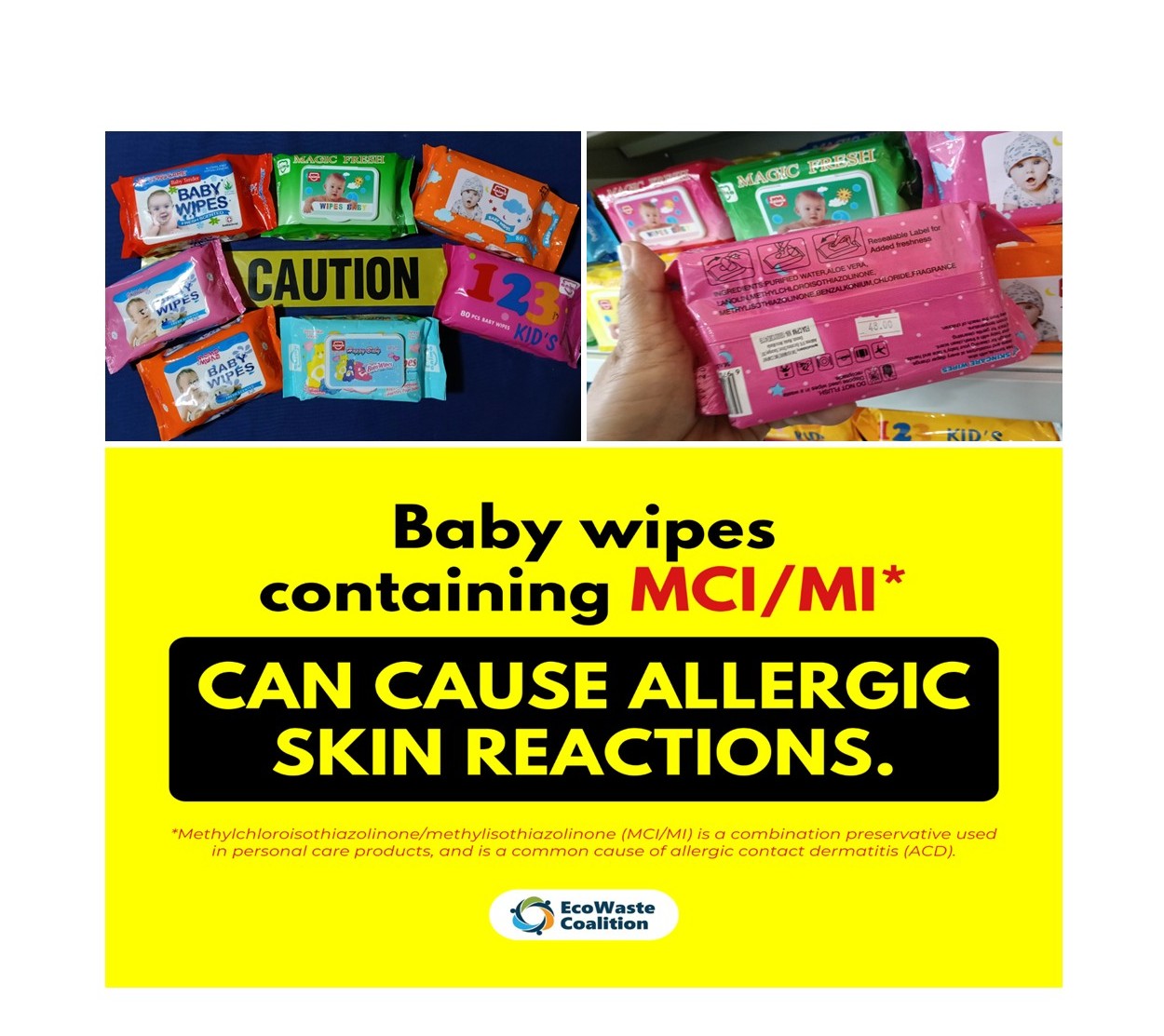
(Groups warn vs. wet wipes with banned preservatives)
26 February 2026, Quezon City. The breastfeeding advocacy group Arugaan and the toxics watchdog group EcoWaste Coalition jointly reminded mothers and caregivers to pay attention to the list of ingredients of wet wipes, as some products may contain banned preservatives known to cause skin allergic reactions.
“Consumers are advised to read the product label very carefully as some products marketed for cleaning the skin of young children, particularly the baby’s hands, mouth and bottom, may contain allergy-causing substances,” said Innes Fernandez, Executive Director, Arugaan.
“Better stick to lukewarm water, mild soap, and cotton balls for routine diaper changes, saving wet wipes for when you’re on the go and water isn’t handy,” she suggested.
“It’s indeed better to minimize the use of wet wipes as most of them contain plastic fibers that don’t break down easily, contributing to residual waste and the so-called ‘fatbergs’ in the sewer system,” said Aileen Lucero, National Coordinator, EcoWaste Coalition. “Every wet wipe you don’t use helps keep plastics and microplastics out of the environment.”
The group called for consumer vigilance after it discovered seven brands of baby wipes listing methylchloroisothiazolinone (MCI) and methylisothiazolinone (MI) as ingredients on sale in at least three retail establishments in Antipolo City.
Based on the hazardous product monitoring it conducted on February 22, the following wet wipes with MCI/MI are sold from as low as P15 to P53 per pack: Animo 123 Kid’s Baby Wipes; Animo Baby Wipes; Animo Happy Baby Baby Wipes; Animo Magic Fresh Baby Wipes; Kim Best Baby Wipes; Mama Baby Wipes; and New Lovedcare Baby Tender Baby Wipes.
The above products were manufactured in 2025, way past the 2018 grace period for the removal of such substances in leave-on cosmetics as discussed in FDA Circular No. 2017-006 and reiterated in FDA Advisory No. 2018-034. Of the seven products with MCI/MI, six will expire in three years, or in 2028, and one in two years, in 2027.
MCI/MI, a combination preservative against bacteria, molds, and yeast, often used in personal care products, is a well-known potent cause of allergic contact dermatitis.
Contact dermatitis, according to the Philippine Dermatological Society (PDS), “is skin inflammation or eczema that is triggered by substances that come in contact with the skin.” Such substances may be a chemical, biological, or physical agent.
To avoid children’s exposure to sensitizing chemicals in some wet wipes, the EcoWaste Coalition and Arugaan reminded parents and caregivers to consider these tips:
a. Use lukewarm water, mild soap, and cotton balls for cleaning the baby’s hands, mouth, and bottom, and only use wet wipes when water is not available.
b. If wet wipes are preferred, go for products with a valid FDA authorization.
c. Check the FDA product verification portal (https://verification.fda.gov.ph/) before making a purchase.
d. Read the product label carefully and shun those that include methylchloroisothiazolinone and methylisothiazolinone as ingredients.
e. Reject products that do not list their ingredients and do not have an expiry date.
f. Look for alcohol-free and unscented wet wipes.
g. Avoid using wipes on broken or irritated skin.
h. After using wet wipes, rinse with water to get rid of chemical residues and reduce the risk of skin allergies.
The groups further urged consumers to properly dispose of used wipes, highlighting how improper disposal clogs pipes, spoils recyclables, and worsens ocean debris.
The EcoWaste Coalition has already informed the FDA about this breach of the MCI/MI ban in leave-on cosmetics, requesting it to take appropriate action to protect young consumers from sources of allergic contact dermatitis. #
Reference: