EcoWaste Coalition Raises Awareness on Dangers of Button Batteries in Children’s Toys
1 December 2025, Quezon City. Parents beware, button batteries used to power some toys may pose serious health risks to their children and must be kept out of their sight and reach at all times to prevent kids from playing with them and accidentally putting them into the mouth, nose, and ears.
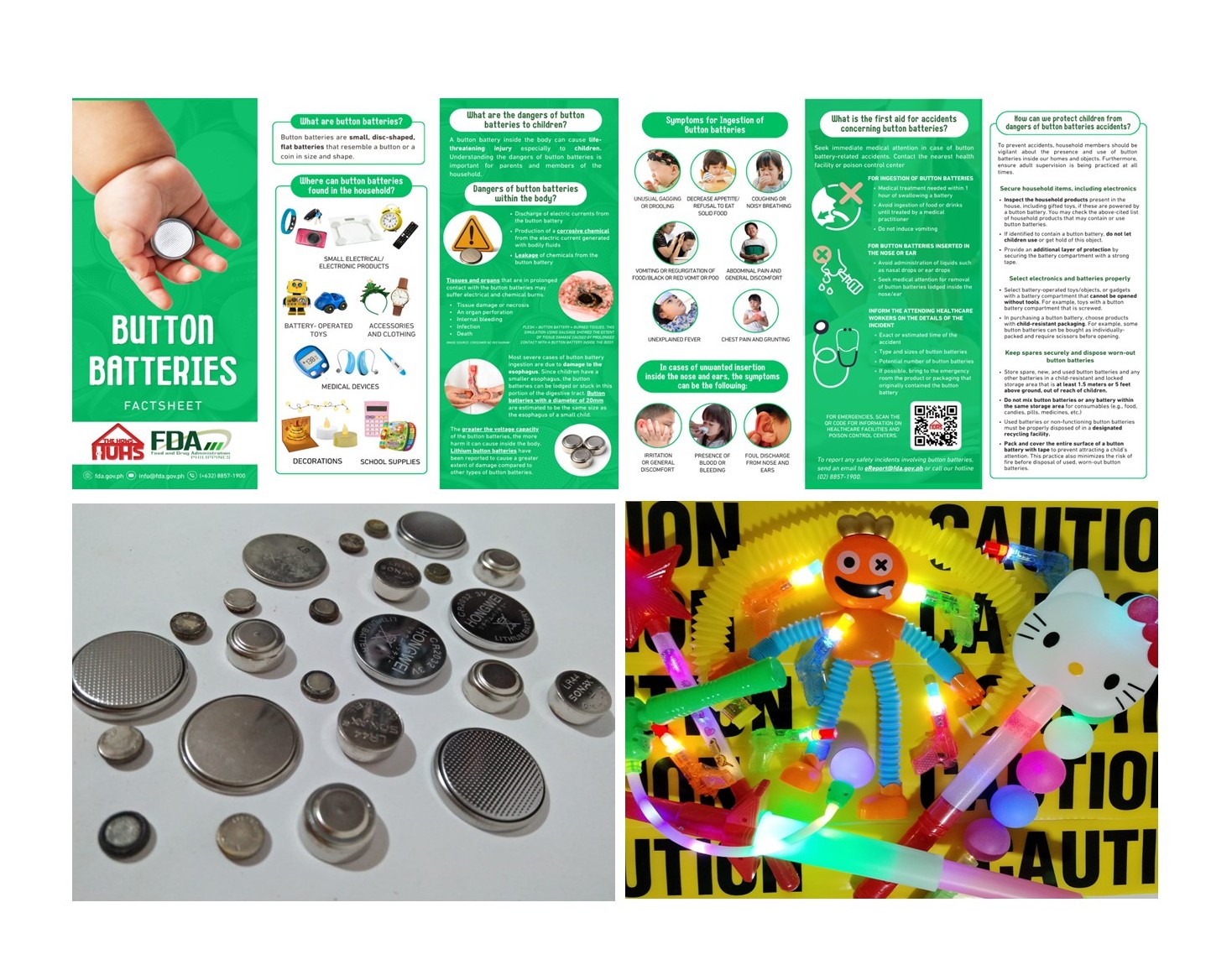
As part of its advocacy towards a safe and healthy celebration of the festive holidays, the EcoWaste Coalition reminded parents to pay close attention to button batteries used in toys, hair accessories, and wrist watches, as well as in common household items such as calculators, thermometers, and other portable electronic devices.
The group issued the reminder after monitoring the sale last Friday of cute but unauthorized light-up toys in Carriedo St., Quiapo, Manila, a few weeks before Christmas and New Year. Sold for P50 to 75 each, the toys provided no hazard warnings and other mandatory labeling information as required by RA 10620, or the Toy and Game Safety Labeling Act.
The EcoWaste Coalition emphasized the importance of button battery safety awareness, especially during the Christmas gift-giving season, as such small but dangerous batteries can seriously threaten a child’s health:
A. If ingested, the button battery can get stuck or lodged in the throat and cause chemical burns.
B. If pushed into the nasal cavity, the button battery may cause mucous membrane injury, fissure or hole in bone and cartilage of the nose, scar tissues, and cause cellulitis of the eyelid.
C. If inserted in the ear canal, this may result in hearing loss, perforation of the eardrum, and facial nerve paralysis.
According to the Button Batteries Fact Sheet published by the Food and Drug Administration (FDA), the symptoms for button battery ingestion include: unusual gagging or drooling, loss of appetite, coughing or nose breathing, vomiting, unexplained fever, chest pain and grunting, abdominal pain, and general discomfort.
The symptoms for the unwanted insertion of button batteries inside the nose and ears are the presence of blood or bleeding, foul discharge, irritation or general discomfort, the FDA added.
To prevent incidents of button battery poisoning, the EcoWaste Coalition urged parents and other gift-givers to observe the following safety reminders:
1. Refrain from buying toys with loosely installed batteries, unregistered, inadequately labeled and not verified as safe by health authorities.
2. If battery-powered toys cannot be avoided, choose one that has a battery compartment that is properly secured with a screw to prevent the child’s access.
3. Carefully read the product safety precautions and instructions.
4. Don’t change or insert batteries in front of small children who may be enticed to do the same.
5. Make sure that button batteries are mercury-free or marked “0% Hg Cell.”
6. Keep old and new button batteries out of children’s reach, as these can pose a poisoning hazard.
7. Avoid storing or leaving batteries where they might be mistaken for, or eaten with, food.
8. Store spent batteries in a sealed childproof container to prevent kids from playing with them.
9. Do not throw spent button batteries in the regular trash. Gather used batteries in a secure container and bring them, along with your other e-waste, to drop-off locations near you.
10. If a button battery is swallowed or placed on the ear or nostril, contact the nearest local poison control center, or call the National Poison Management and Control Center (NPMCC) 24-hour hotline at +85260062 or +632-85241078. Seek immediate medical attention.
The ingestion of button batteries is among the top 10 leading causes of poisoning in 2023 among inpatient referrals (pediatric cases) in the Philippines, according to the NPMCC.
For further information about button battery safety awareness, please refer to FDA Advisory No. 2025-1409 and the Button Batteries Fact Sheet published by the FDA Center for Cosmetics and Household/Urban Hazardous Substances Regulation and Research (CCHUHSRR). #
Reference:
https://www.healthychildren.org/English/safety-prevention/at-home/Pages/Button-Battery-Injuries-in-Children-A-Growing-Risk.aspxhttps://www.fda.gov.ph/wp-content/uploads/2025/11/FDA-Advisory-2025-1409.pdf