Clean Air Asia Announces Opening of the 12th Better Air Quality Conference (BAQ) 2026 in Bangkok
Bangkok, Thailand — 9 March 2026 — Clean Air Asia, in partnership with the Asian Development Bank (ADB), the Climate and Clean Air Coalition (CCAC), the United Nations Economic and Social Commission for Asia and the Pacific (ESCAP), and the United Nations Environment Programme (UNEP), is proud to announce the opening of the 12th Better Air Quality conference (BAQ) 2026.
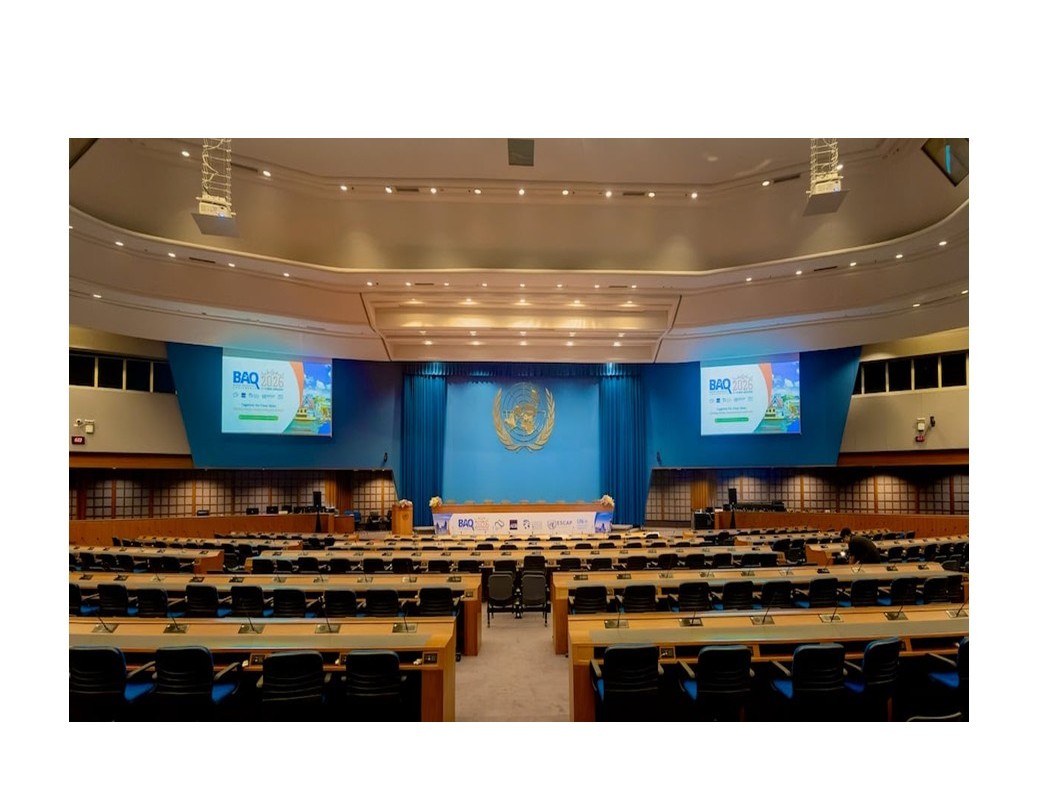
Taking place from 11–13 March 2026, BAQ 2026 will convene at the United Nations Conference Centre (UNCC) in Bangkok, Thailand. BAQ 2026 brings together over 1,100 policymakers, technical experts, advocates, funders, the private sector, and other stakeholders from 56 different countries to drive collaborative action for cleaner air and healthier communities.
Air pollution remains one of the leading environmental health risks worldwide. One in eight deaths worldwide is attributed to air pollution, according to the Health Effects Institute State of Global Air 2025 Report. In 2021, WHO strengthened its Global Air Quality Guidelines, lowering the recommended annual limit for fine particulate matter (PM2.5) to 5 µg/m³ to reflect evidence that even low levels of exposure are harmful. Yet 99% of the global population now breathes air that exceeds WHO guideline limits, underscoring the scale and urgency of the challenge.
The BAQ conference has become the region’s leading platform for advancing integrated solutions to air pollution. Previous editions have brought together governments, researchers, civil society, development partners, and the private sector to share knowledge and catalyse action. In 2026, Thailand takes centre stage.
The selection of Bangkok reflects both the country’s leadership role in regional environmental cooperation and the urgency of addressing air pollution challenges that affect urban and rural communities alike, from transport emissions and industrial activity to agricultural burning and transboundary pollution. As a regional hub for diplomacy and multilateral engagement, Thailand provides a strategic setting to strengthen collaboration across borders and sectors.
“We are proud to welcome delegates from around the world to BAQ 2026,” said Bjarne Pedersen, Executive Director of Clean Air Asia. “With the theme, ‘Together for Clear Skies: Driving Action, Accelerating Investment’, this year’s conference underscores the urgent need for collective investment, strengthened partnerships, and meaningful action to reduce air pollution and unlock health, economic, and climate benefits for all.”
“Improving air quality is fundamental to sustainable development across Asia and the Pacific,” said Yoko Watanabe, Director – Environment, ADB. “ADB is committed to supporting our member countries to strengthen air quality management, accelerate clean energy transitions, modernise transport systems, and mobilise finance for air pollution solutions at scale. BAQ 2026 provides a critical platform to align policy ambition with the investments needed to provide cleaner air and support healthier communities across Asia and the Pacific.”
Key Objectives of BAQ 2026 Include:
* Unlocking financing and investment to support scalable, sustainable solutions that deliver long-term health and economic resilience.
* Driving multi-sectoral action and cooperation on integrated solutions to reduce emissions from transport, energy, industry, waste, agriculture, and other major sources.
* Building stronger partnerships across governments, funders, the private sector, technical experts, and civil society to catalyse transformative change.
Participants will engage in high-level plenaries, thematic sessions, and practical discussions that spotlight innovative approaches, financing mechanisms, and cross-sectoral strategies to improve air quality and deliver co-benefits for climate and health across the region. A highlight of BAQ 2006 will be financing roundtables aimed at accelerating funding for clean air programs and projects in Asia.
Additional details about the conference and the full program can be found at cleanairasia.org/BAQ
About Clean Air Asia:
Clean Air Asia is leading the regional mission for better air quality, and healthier, more livable cities throughout Asia. Its mission is to reduce air pollution and greenhouse gas emissions in Asia and contribute to the development of a more sustainable, equitable and healthier region.
For 25 years, Clean Air Asia has empowered governments and cities by inspiring action and focusing efforts on the planning and implementation of solutions at scale, fostering regional cooperation, and ensuring the integration of air quality management across sectors and institutions. www.cleanairasia.org
About the BAQ
Clean Air Asia’s biennial Better Air Quality (BAQ) Conference, launched in 2002, is the region’s largest and most prestigious air quality gathering, bringing together hundreds of policymakers, stakeholders, world-renowned experts, academics, and industry leaders in a spirit of unity and shared purpose in collaboratively addressing the critical issue of air pollution. www.cleanairasia.org/BAQ
Asian Development Bank
ADB is a leading multilateral development bank supporting inclusive, resilient, and sustainable growth across Asia and the Pacific. Working with its members and partners to solve complex challenges together, ADB harnesses innovative financial tools and strategic partnerships to transform lives, build quality infrastructure, and safeguard our planet. Founded in 1966, ADB is owned by 69 members—50 from the region.
Climate and Clean Air Coalition
The Climate and Clean Air Coalition is a partnership of over 200 governments, intergovernmental organizations, and non-governmental organizations.
The Coalition works to reduce powerful but short-lived climate pollutants (SLCPs) – methane, black carbon, hydrofluorocarbons (HFCs), and tropospheric ozone – that drive both climate change and air pollution.
The Coalition aims to connect ambitious agenda setting with targeted mitigation action within countries and sectors. Robust science and analysis underpin all efforts, and bolstered by the CCAC Trust Fund, the Coalition has given rise to high-level political commitment, in-country support, and a range of tools that help make the case for action and support implementation.
Economic and Social Commission for Asia and the Pacific
The Economic and Social Commission for Asia and the Pacific (ESCAP) is the most inclusive intergovernmental platform in the Asia-Pacific region. The Commission promotes cooperation among its 53 member States and 9 associate members in pursuit of solutions to sustainable development challenges. ESCAP is one of the five regional commissions of the United Nations. ESCAP provides secretariat services for the implementation of the Regional Action Programme on Air Pollution (RAPAP). Adopted in 2022 by ESCAP member States, RAPAP aims to promote clean air for all in Asia and the Pacific through (i) Promoting science-based and policy-oriented cooperation (ii) establishing an open regional platform for best practices exchange (iii) promoting domestic actions and regional cooperation (iv) Identifying technical and financial resources for multilateral and cooperative action, and (v) Fostering dialogue and technical cooperation.
UN Environment Programme (UNEP)
UNEP is the leading global voice on the environment. It provides leadership and encourages partnership in caring for the environment by inspiring, informing and enabling nations and peoples to improve their quality of life without compromising that of future generations.