Ateneo robot explorers uncover the Philippine island’s ancient technologies
Danika Geronimo, Ateneo de Manila University Research Communications
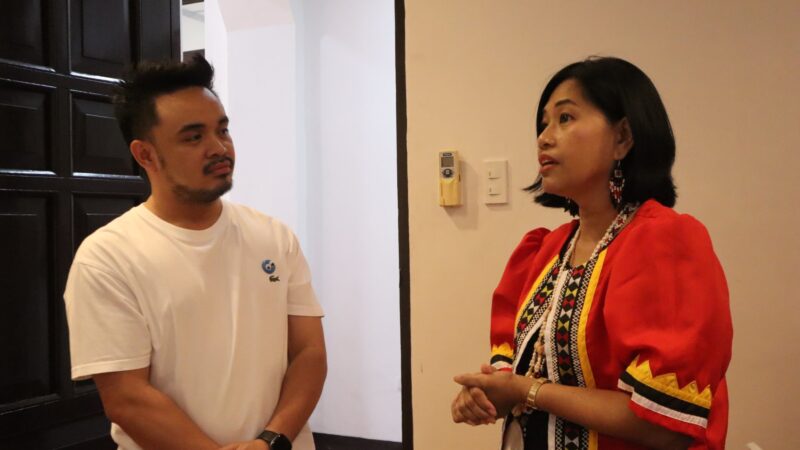
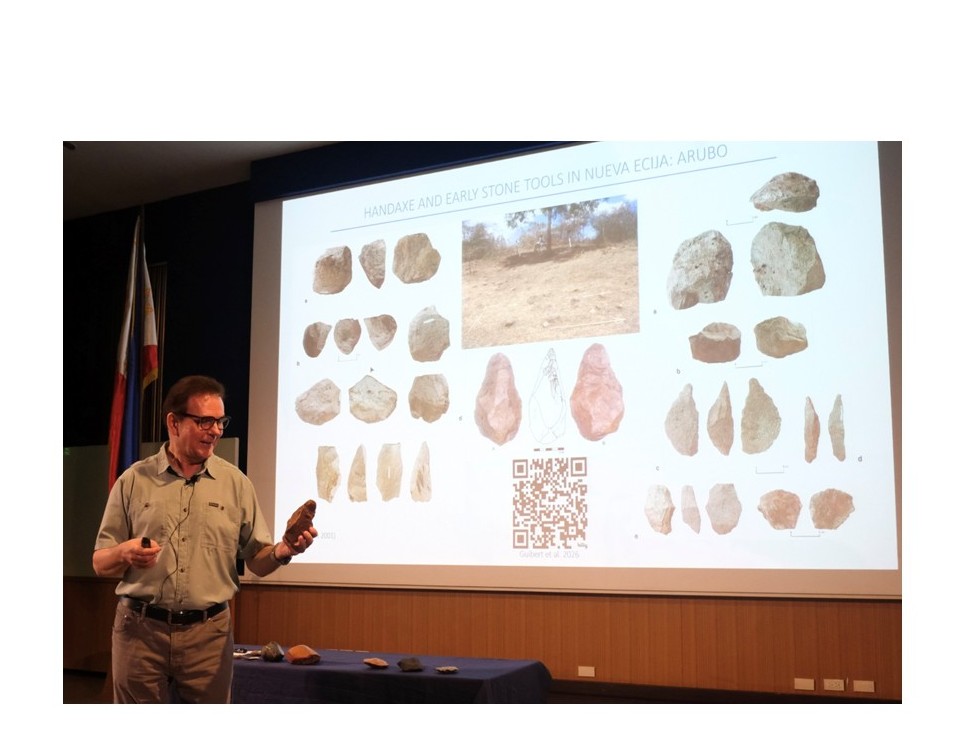
In the Photo. Dr. Alfred Pawlik showcases early stone tool artifacts, detailing archaeological evidence of the seafaring and hunting strategies used by the early inhabitants hundreds of thousands of years ago to thrive across the Philippine archipelago. SOURCE: OAVP-RCWI, 2026.
Long before the first Spanish ships arrived on our shores, the Philippine islands were already home to daring seafarers with technology that enabled them to cross vast stretches of open seas, hunt formidable marine life, and build lives in a world that was anything but forgiving.
Centuries later, new transformative technologies are reshaping how we explore this distant past. In the latest Ateneo Breakthroughs lecture, archaeologist Dr. Alfred Pawlik introduced ArchaeoBot, a pioneering collaboration with the Ateneo Laboratory for Intelligent Visual Environments (ALIVE). By integrating robotics and machine learning into archaeological excavation, the project enhances precision, minimizes human error, and reveals details that further deepen our understanding of early human life in the region.
Through these innovations, Dr. Pawlik–a professor at the Department of Sociology and Anthropology at the Ateneo de Manila University–brings audiences deeper into both archaeological discovery and emerging technologies. His work, focused on Southeast Asian archaeology, hunter-gatherer societies, and past human behavior, is matched by his roles as Research Coordinator of the Dr. Rosita G. Leong School of Social Sciences and Director of the Anthropological and Sociology Institute of Ateneo.
These forgotten chapters of our history took center stage in his lecture on 27 March 2026 at Escaler Hall, where he connected ancient history with modern innovation.
View Pawlik’s full lecture at ateneo.edu/breakthroughs
ArchaeoBot is designed to help excavate sites with greater consistency, precision, and care than via manual methods. As Dr. Pawlik explained, the idea grew out of a long-standing ambition to build a machine that could take on the physically demanding parts of excavation while also reducing the kinds of human error that can happen in the field—especially when teams are tired, inexperienced, or working across multiple trenches at once. In practice, ArchaeoBot is imagined not simply as a digging machine, but as a smart, multipurpose system that can detect finds, recognize archaeological features and contexts, and carefully retrieve objects without damaging them.
What makes ArchaeoBot especially innovative is that it combines robotics, sensing, and machine learning into a single archaeological platform. The robot is equipped with various sensors that enable it to identify potential artifacts, burials, hearths, and other subtle traces that people might miss or only notice too late. It is also meant to learn from experience, adapt to different excavation conditions, and eventually go beyond digging by helping with cleaning, recording, bagging, and storage of delicate finds. In that sense, it is envisioned as a kind of one-stop archaeological assistant: not replacing archaeologists entirely but extending what they can do and making the whole process more systematic.
In his lecture, Pawlik presented evidence that, by around 40,000 years ago, humans were already venturing across island chains such as Palawan and Mindoro. Even more astonishing, earlier people reached Luzon hundreds of thousands of years ago. He asserts that these weren’t accidental wanderings, since most of the Philippine archipelago was never connected to the mainland during the Ice Age, making these journeys dependent on what were likely very deliberate and repeated sea crossings.
Central to this movement is the “Palawan-Mindoro Corridor,” a likely route that positions the Philippines not as a remote endpoint, but as a crucial gateway in the wider story of human migration across Southeast Asia.
Recent archaeological discoveries reveal just how capable these early communities were. The remains of tuna, sharks, and other pelagic species indicate advanced fishing strategies, while bone gorges and modified stone weights suggest a mastery of marine technology that endured for millennia.
Yet survival on these islands demanded more than skill at sea. Early people also depended on plants to thrive. Far from being passive settlers, they were adaptive innovators who learned to work with the rhythms and risks of both land and ocean.
Today, together with ArchaeoBot, these experimental and interdisciplinary efforts aim to reconstruct not only artifacts but entire systems of knowledge, making visible the invisible technologies that rarely survive in the archaeological record.
“We owe the anthropologists and their scholarship that we get a better picture of generations and civilizations to which we would otherwise have no access,” said Dr. Maria Luz Vilches, Vice President for Higher Education, in her opening remarks.
Taken together, the research underscores that the Philippine archipelago has long been a space of movement, ingenuity, and connection. #