FDA Flags Unauthorized Cosmetics Reported by the EcoWaste Coalition Containing Mercury
(FDA issues 8 public health warnings in response to the group’s market monitoring reports)
19 May 2026, Quezon City. The Food and Drug Administration (FDA) has flagged multiple imported skin lightening products, cautioning the public not to buy or use them. Eight of these items were previously identified by the EcoWaste Coalition as contaminated with mercury.
Six of the eight FDA advisories were issued on April 23 and posted on the FDA website on May 18. The other two were issued on March 23 and February 10 and posted on May 8 and 6, respectively.
“We commend the FDA for its decisive response to our alerts exposing the illegal trade of mercury-laced skin lighteners, which stand in brazen violation of the ASEAN Cosmetic Directive and the Minamata Convention on,” said Aileen Lucero, National Coordinator, EcoWaste Coalition. “We urge the public to follow health authority warnings to shield their bodies, homes, and the ecosystems from toxic mercury.”
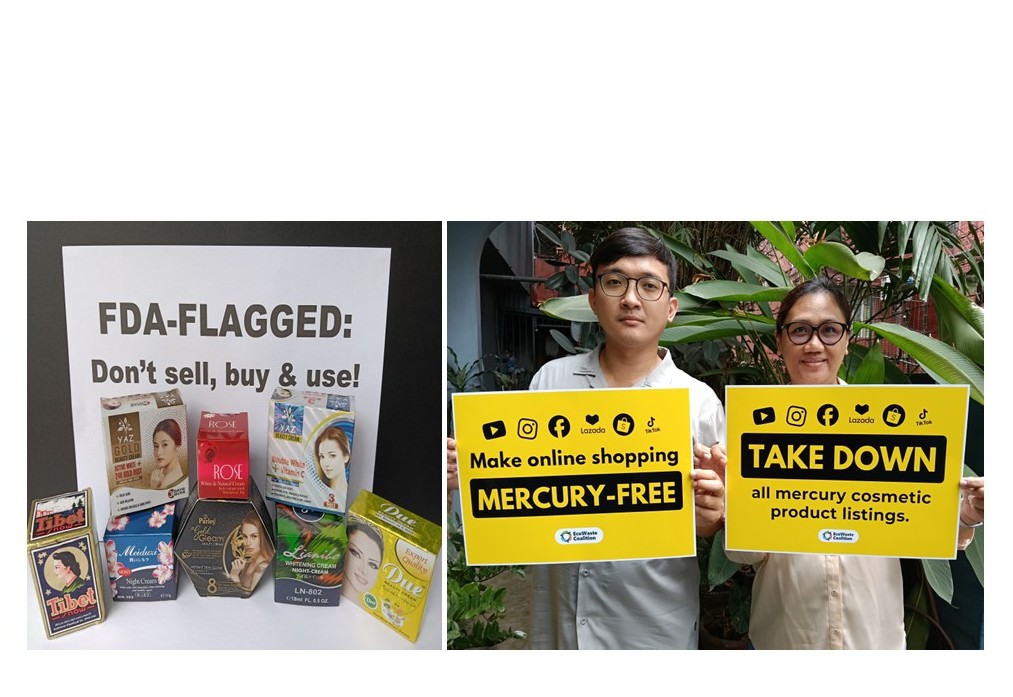
“As we obtained the flagged products online, we call on e-commerce platforms to take down the corresponding listings at once,” Lucero added. “Online shopping and social media platforms must ensure that their sites are not used to generate profits at the expense of public health and the environment.”
Aside from warning consumers about the risks of using such products, the FDA also directed concerned establishments to cease advertising, distributing, or selling the flagged products until FDA authorization is secured, or face regulatory actions and sanctions.
Among the mercury-laced products reported by the EcoWaste Coalition, which the FDA subsequently flagged for lacking the required market authorization, were Pakistan-made Due Beauty Cream, Parley 24K Gold Gleam Beauty Cream, Tibet Snow, Yaz Beauty Cream Double White + Vitamin C, and Yaz Gold Beauty Cream Active White + 24K Gold Dust.
Also flagged were Rose White & Natural Cream Moisturizer from Indonesia, Lianibo Whitening Night Cream, and Meiduzi Night Cream, both from Taiwan.
According to the FDA, the use of unauthorized cosmetics may pose health risks to consumers. “Potential hazards may come from ingredients that are not allowed to be part of a cosmetic product or from the contamination of heavy metals. The use of substandard and possibly adulterated cosmetic products may result in adverse reactions, including, but not limited to, skin irritation, itchiness, anaphylactic shock, and organ failure.”
Before buying or using any cosmetic product, the FDA advises consumers to always check whether it has FDA authorization using the FDA Verification Portal at https://verification.fda.gov.ph.
To protect consumer health and well-being, the FDA requested its Regional Field Offices and Regulatory Enforcement Units, in coordination with Local Government Units (LGUs) and other law enforcement agencies, to prevent the distribution and sale of the flagged products within their jurisdiction.
The public may report any sale, distribution, complaint, and/or adverse event resulting from the use of the violative cosmetic products through ereport@fda.gov.ph.