Toxics Watchdog Reminds Consumers to Choose Safe Swimming Floater Toys for Kids
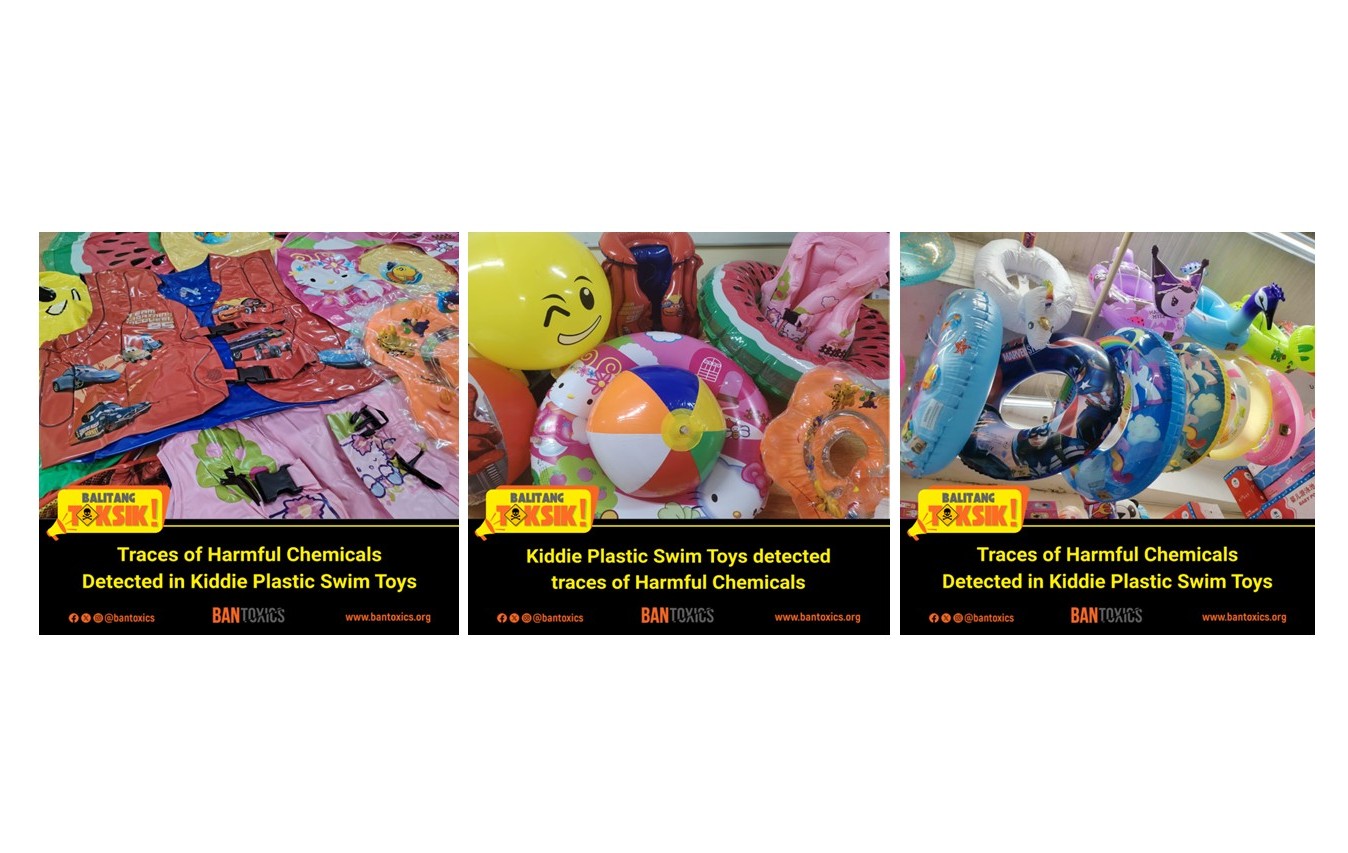
With the heat index on the rise, swimming activities at beaches and pools have become a popular and enjoyable way for the public, especially kids, to cope with the scorching heat. However, toxic watchdog BAN Toxics reminds the public to exercise caution when buying plastic swimming floater toys that may contain hazardous chemicals.
In a recent market monitoring activity, the group photographed, documented, and purchased samples of kiddie swimming floaters — such as swim rings, beach balls, baby swimming laps, and swim vests — with prices ranging from ₱90 to ₱150 each, from toy stores in Metro Manila and Tacloban. Most of the samples have limited product information, failing to meet the labeling requirements under RA 10620, also known as the Toy and Game Safety Labeling Law.
Using a Vanta C Series Handheld XRF Analyzer, the group tested the products and discovered lead levels exceeding 200 parts per million (ppm), mercury levels of up to 600 ppm, and cadmium levels of up to 151 ppm — all of which exceeded toy safety standards.
Some samples are suspected to contain PVC or polyvinyl chloride — a plastic material to which chemical additives such as phthalates are added as softeners. These additives are also used as stabilizers and colorants, and they improve elasticity and durability. According to the Environmental Working Group, phthalates are a class of chemicals with endocrine-disrupting properties. Existing research shows that PVC and its plasticizers pose serious health risks, including increased risk of cancer, asthma and allergies, endocrine disruption, reproductive and immune system damage, learning, attention, and behavioral difficulties, and harm to child development.
“The presence of hazardous chemicals in plastic-made swimming toys has the potential to interfere with children’s growth and development,” said Thony Dizon, Advocacy and Campaign Officer of BAN Toxics. “Toys that are unsafe for children should be immediately removed from the market to prevent chemical exposure to children and the environment.”
In 2011, the Department of Health (DOH) issued Administrative Order No. 2009-0005-A to regulate the use of phthalates in children’s toys in the country. The order prohibits any person from manufacturing for sale, offering for sale, distributing in commerce, or importing into the country any children’s toy that contains a concentration of more than 0.1 percent of di-(2-ethylhexyl) phthalate (DEHP), dibutyl phthalate (DBP), or benzyl butyl phthalate (BBP).
Meanwhile, according to the World Health Organization, lead is a well-recognized toxicant with wide-ranging health impacts, affecting the neurological, cardiovascular, gastrointestinal, and haematological systems. Young children are particularly vulnerable because they have higher exposure than adults and because lead affects the developing brain, potentially resulting in reduced intellectual ability.
In a toy study published in 2024 by BAN Toxics and the Environmental and Social Development Organization (ESDO) in Bangladesh, other chemicals, such as mercury and cadmium, found in toys are linked to serious health and environmental risks. Mercury can lead to neurocognitive and behavioral disturbances, renal damage, peripheral neurotoxicity, and cardiovascular problems. Cadmium can cause lung cancer, obstructive pulmonary disease, neurodevelopmental issues, and reduced bone mineral density.
The Philippines has promulgated its toy safety standards through the Philippine National Standard (PNS) on Safety of Toys. The PNS covers safety aspects, including those related to mechanical and physical properties, flammability, migration of certain elements in toys, determination of total concentrations of certain elements in toys, certain phthalate esters in toys, and age determination guidelines.
“Despite the existing regulations in the country, the continued selling of unnotified and unregistered toys and other children’s products persists. We appeal to the FDA and DTI to conduct enforcement action against unsafe toys and childcare articles being sold in the market to protect the public, especially children, from toxic harm,” the group added.
As part of its Safe Toys for Kids campaign, BAN Toxics reiterated the following recommendations to address the gaps in regulations on toy safety and chemicals in plastics:
- National toy safety standards should align with international guidelines, incorporating stricter regulations on toxicity and improving enforcement to protect children from chemical risks. National regulations should be updated to reflect the latest international standards, with a focus on restricting chemicals known or suspected to have carcinogenic, mutagenic, or reprotoxic effects. This should include substances beyond the common eight migratable elements and six ortho-phthalates, specifying clear requirements for these chemicals.
- Transparency and traceability measures, such as harmonized labeling of chemicals used in toy production, are essential for improving monitoring and control. BAN Toxics likewise recommends further investigation into the transboundary hazardous toy trade to inform policies addressing this issue at the regional or international level. Stricter enforcement of these regulations will enhance coordination and strengthen countries’ efforts to regulate harmful toys.
- Enhancing the enforcement of legal requirements — particularly for imported toys — requires a review and strengthening of regulatory agencies. Additional measures should be imposed on manufacturers, importers, and distributors to prevent hazardous toys from entering the market and to swiftly address risks once products are available. Regulatory bodies must be equipped to closely monitor trade, identify potential hazards, and remove unsafe toys when risks are detected. #